Performance
Use hyperfine Warmups, Prepare Commands and Parameter Scans
Control hyperfine 1.19 with --warmup, --prepare, --setup, --cleanup and --parameter-scan to measure cold and warm runs and sweep threads or compilers.
7 min read
Everything you need to level up your coding skills.
Control hyperfine 1.19 with --warmup, --prepare, --setup, --cleanup and --parameter-scan to measure cold and warm runs and sweep threads or compilers.
Extract a recipe's source into a Git tree with devtool modify on Yocto 5.0, edit and rebuild it, then turn your commits into patches with devtool finish.
Move a NASM boot sector into 32-bit protected mode, set up a flat GDT and a stack, then call a freestanding C function that writes to VGA text memory.
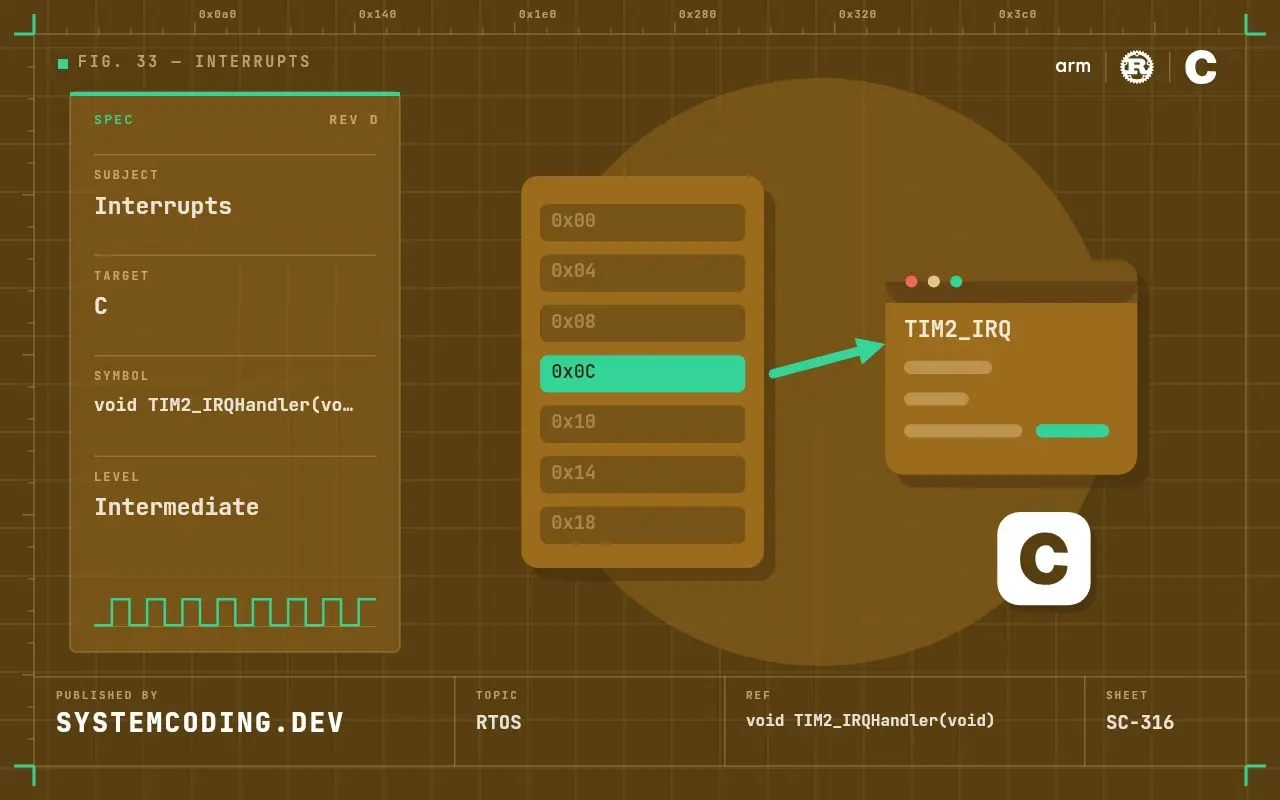
Run a function at task level from a FreeRTOS interrupt with xTimerPendFunctionCallFromISR: arguments, config flags, failure modes and alternatives.
See where C variables live: the stack for locals that vanish on return, the heap for data you free yourself. Learn the limits, costs and bugs of each.
Run a USB CDC serial port on the ESP32-S3 native USB pins with esp_tinyusb in ESP-IDF 5, and know what happens to the built-in USB serial and JTAG.
Expose an SPI device as /dev/spidevB.C, set mode, speed and word size with ioctl, and run full-duplex transfers with SPI_IOC_MESSAGE in a small C program.
Compare AXI4-Lite, Wishbone B4 and APB for a custom FPGA register block on cost, handshake, bursts and tool support, with a decision table and slave code.
Build a 6502 CPU core in C11: registers, the status flags, addressing modes, ADC and SBC with overflow, branches with cycle counts, and a small test program.
Compare libFuzzer, AFL++ and honggfuzz on harness style, speed, binary-only support, mutators and platforms, with a decision table and a shared harness.
Choose between float and double in C by precision, range, memory, SIMD width and hardware support, with accumulation examples and a decision table.
Compare libx264 with NVENC, VAAPI, QSV and VideoToolbox in FFmpeg 7.1 on your own footage using VMAF, and decide when speed or quality per bit should win.
We send one email when a new post is published. No spam.