Embedded
Flash Rust Firmware With probe-rs run and Print Logs With defmt
Set probe-rs run as the Cargo runner, add defmt and defmt-rtt, and read log lines from a running Cortex-M board in your terminal with panic-probe.
6 min read
Everything you need to level up your coding skills.
Set probe-rs run as the Cargo runner, add defmt and defmt-rtt, and read log lines from a running Cortex-M board in your terminal with panic-probe.
Match on io::ErrorKind to handle NotFound, PermissionDenied and read-only filesystems from Rust std::fs, and use File::try_lock to detect a locked file.
The SysRq commands that matter for kernel debugging, each with what it does and when not to use it, plus how to enable them and the REISUB sequence.
Decode a real x86-64 NULL pointer oops from a module, one line at a time: fault address, error code, RIP, registers, call trace and taint flags.
Send kernel messages as UDP packets to another host with netconsole, set it up at boot or run time, and receive crash logs that never reach disk.
Tell a kernel warning from an oops, a BUG and a panic by what the kernel does next, which taint flag it sets and which sysctls turn one into another.
Read the kernel ring buffer with dmesg and the journal with journalctl -k, filter by level and time, follow new messages and avoid clock and permission traps.
Learn the eight printk log levels, the pr_info and pr_err helpers, pr_fmt prefixes, rate limiting and the console loglevel that decides what reaches the screen.
Fix the Too many open files error on Linux. Read RLIMIT_NOFILE, raise the soft limit in C, set systemd LimitNOFILE, and find the leak that caused it.
Run a program under strace, read each line as name, arguments and result, then filter, follow child processes and write the trace to a file to find real faults.
Compile with -fsanitize=address to catch heap overflows, use after free, double free and leaks, and learn to read the report that names the exact line.
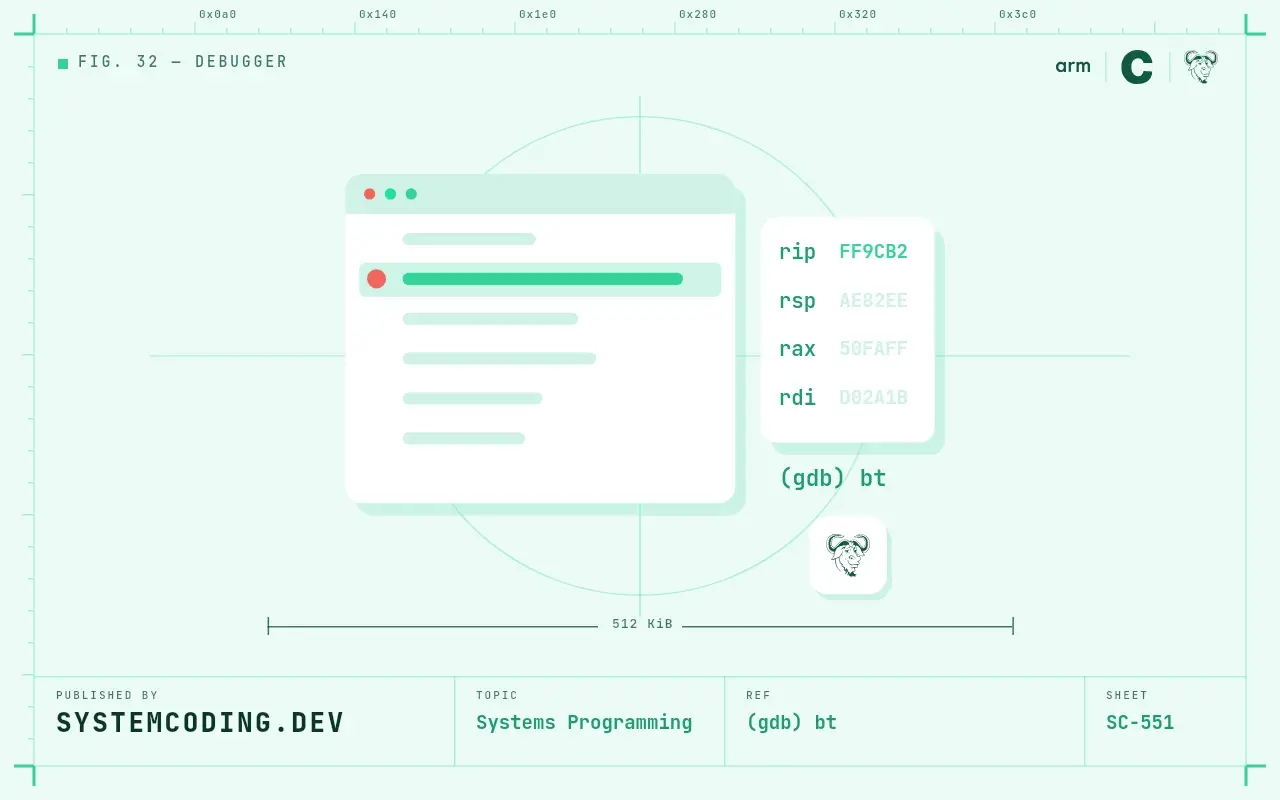
Turn Segmentation fault (core dumped) into a line number: compile with -g, enable core files, open the core in gdb, and read the backtrace and variables.
We send one email when a new post is published. No spam.