
Kernels
Boot Linux on RISC-V in QEMU With OpenSBI and U-Boot
Build OpenSBI, U-Boot and a Linux 6.12 Image for riscv64, boot them on QEMU virt in the real firmware chain and load the kernel from an ext4 disk with booti.
8 min read
Everything you need to level up your coding skills.
Build OpenSBI, U-Boot and a Linux 6.12 Image for riscv64, boot them on QEMU virt in the real firmware chain and load the kernel from an ext4 disk with booti.
Write a Linux 6.12 pin controller driver: pinctrl_desc, pins, groups and functions, the set_mux callback, and the device tree states that consumers select.
Write a Linux 6.12 GPIO controller driver with struct gpio_chip: direction, get and set callbacks, locking, registration and the generic MMIO helper.
Load a firmware blob in a Linux 6.12 driver with request_firmware, validate it, copy it to the device, release it, and use the async variant for early probes.
Drive a PWM channel from a Linux 6.12 consumer driver with devm_pwm_get, struct pwm_state and pwm_apply_might_sleep, plus the device tree binding.
Write a Linux 6.12 RTC driver with rtc_class_ops, read_time and set_time using 64-bit time, range limits, and test it with hwclock and sysfs.
Write a Linux 6.12 watchdog driver with watchdog_device and watchdog_ops, handle the timeout and nowayout options, and see it through /dev/watchdog and wdctl.
Write a Linux 6.12 LED class driver with led_classdev, brightness_set_blocking, max_brightness and triggers, and see it appear under /sys/class/leds.
Write a Linux 6.12 input driver for a GPIO button: devm_input_allocate_device, capability bits, a threaded IRQ, debounce, and events visible to evtest.
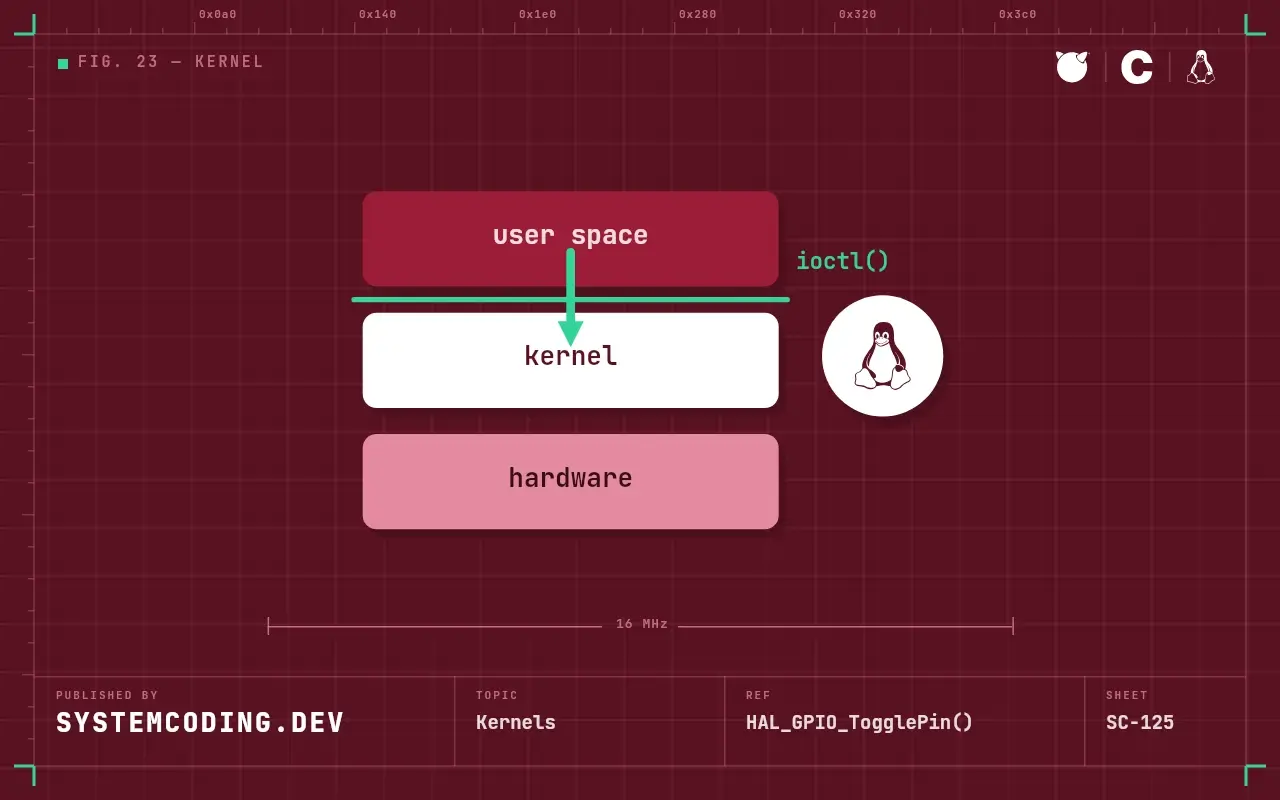
Request, configure and drive GPIO lines from a Linux 6.12 platform driver with devm_gpiod_get and the descriptor API, including active-low handling.
What a Linux 6.12 device driver is, how it reaches hardware through registers, port I/O, DMA and interrupts, and how it presents the device to user space.
Where the Linux 6.12 firmware loader searches for blobs, in what order, how initramfs and built-in firmware fit in, and how to read the failure messages.
We send one email when a new post is published. No spam.