Assembly
What Assembly Language Is and Why Systems Programmers Still Read It
Assembly is a readable spelling of machine code, one line per instruction. See what it is, how to view it for any C function, and when reading it pays off.
6 min read
x86-64, ARM, AArch64 and RISC-V assembly, calling conventions, SIMD, pipelines, caches and memory ordering, and reading the disassembly your compiler wrote.
Assembly is a readable spelling of machine code, one line per instruction. See what it is, how to view it for any C function, and when reading it pays off.
Put code, constants, variables and zeroed buffers into the right ELF sections in NASM and GNU as, and see how segments and permissions follow from them.
Define bytes, words, strings, floats, arrays and zeroed buffers in NASM with db, dw, dd, dq, the res family and times, with exact little-endian layouts.
Assemble a GNU as source file on Linux x86-64 and link it three ways: with ld as a freestanding program, with gcc and libc, and with gcc driving as itself.
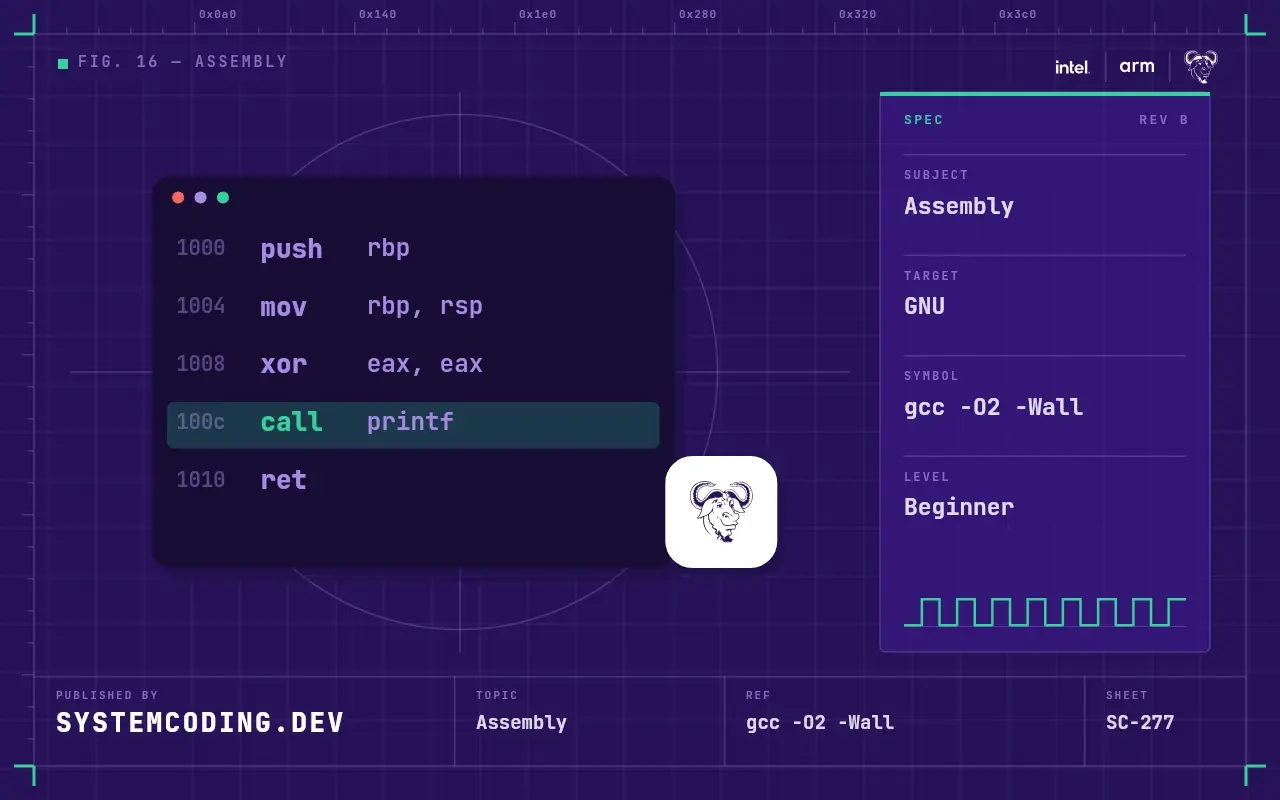
Build the same NASM program two ways on Linux x86-64: a freestanding _start binary linked with ld, and a main function linked with gcc against libc.
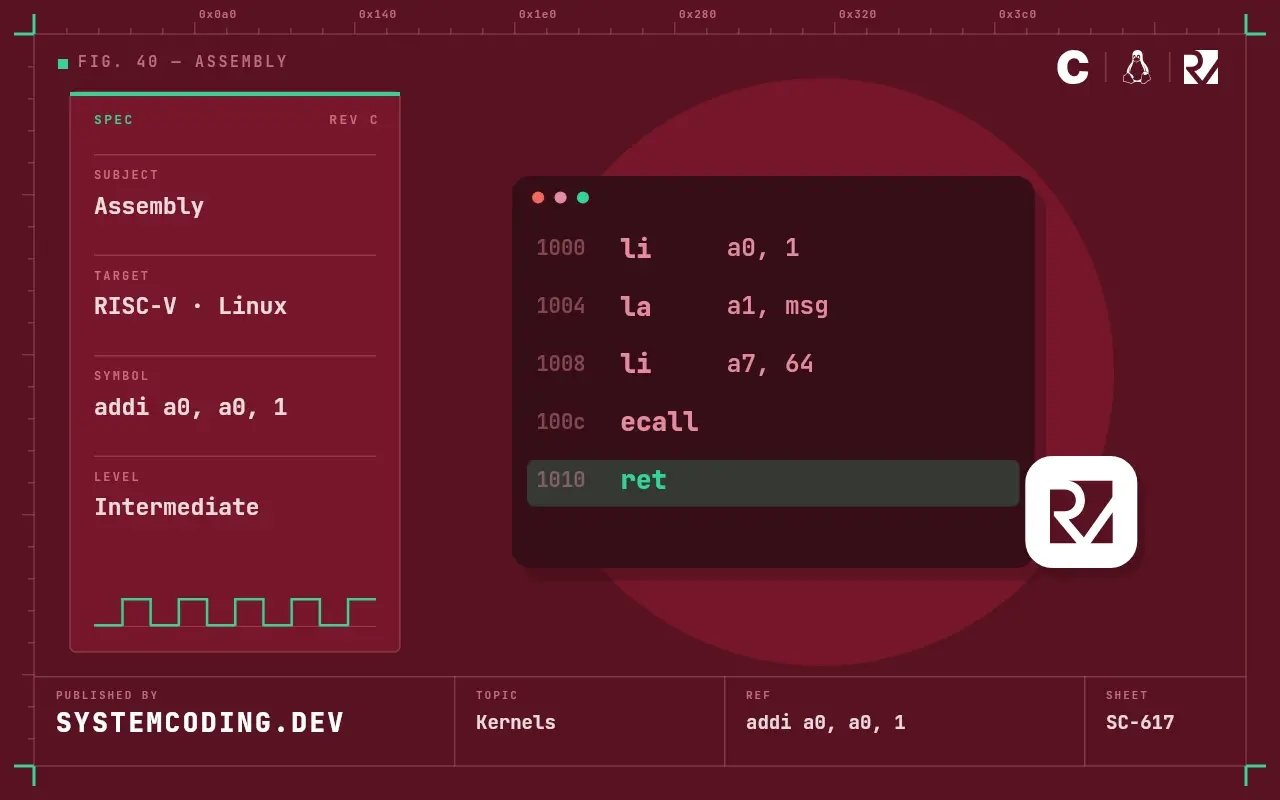
Write a 64-bit RISC-V kernel in C and assembly for QEMU virt: boot through OpenSBI, traps, timer, paging with Sv39, a page allocator, tasks and user mode.
Choose an x86 assembler by platform, syntax, macro power and output formats. A decision table compares NASM, GNU as, MASM and FASM, with when not to pick each.
Read x86 assembly in Intel and AT&T syntax with a six-rule translation method, a side-by-side table of operands and addressing, and a guide to choosing one.
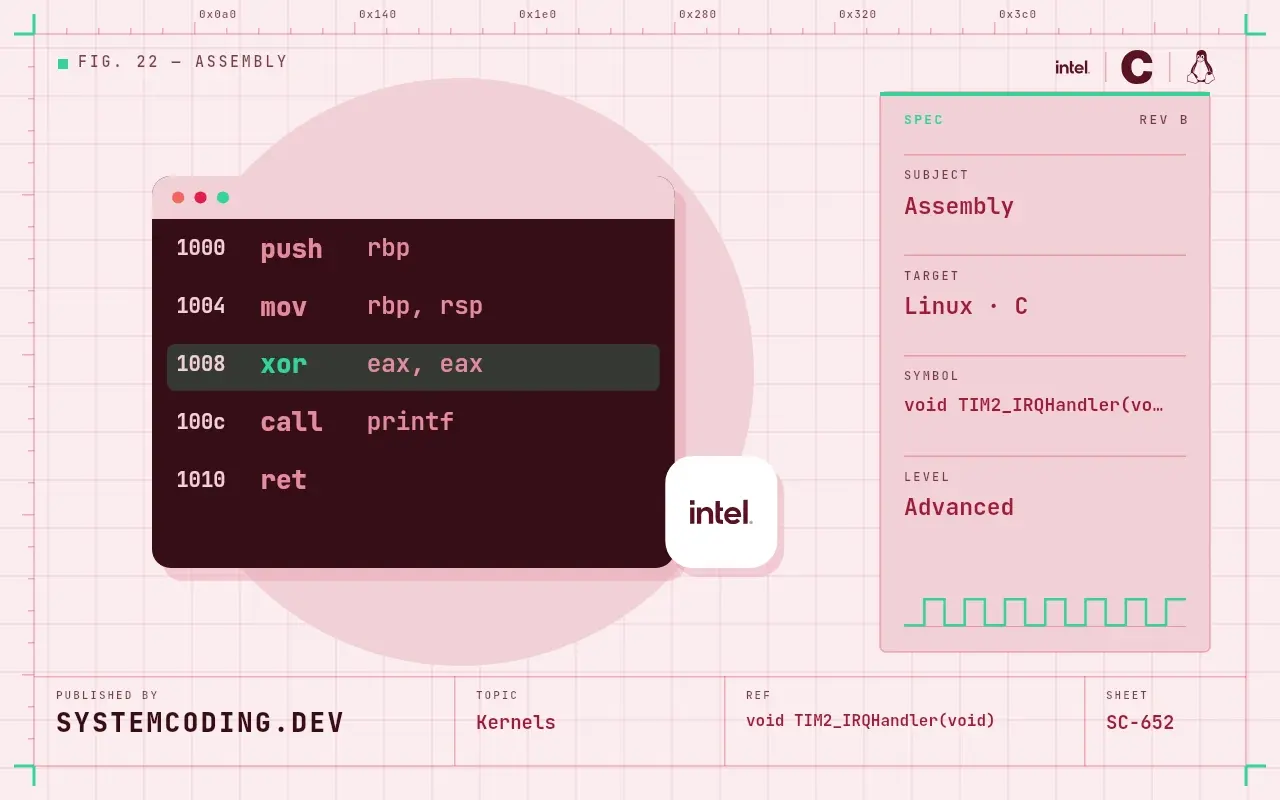
A complete x86-64 kernel core: GDT, IDT, exceptions, PIC and APIC interrupts, timers, a frame allocator, four-level paging, page faults, a heap and PCI.
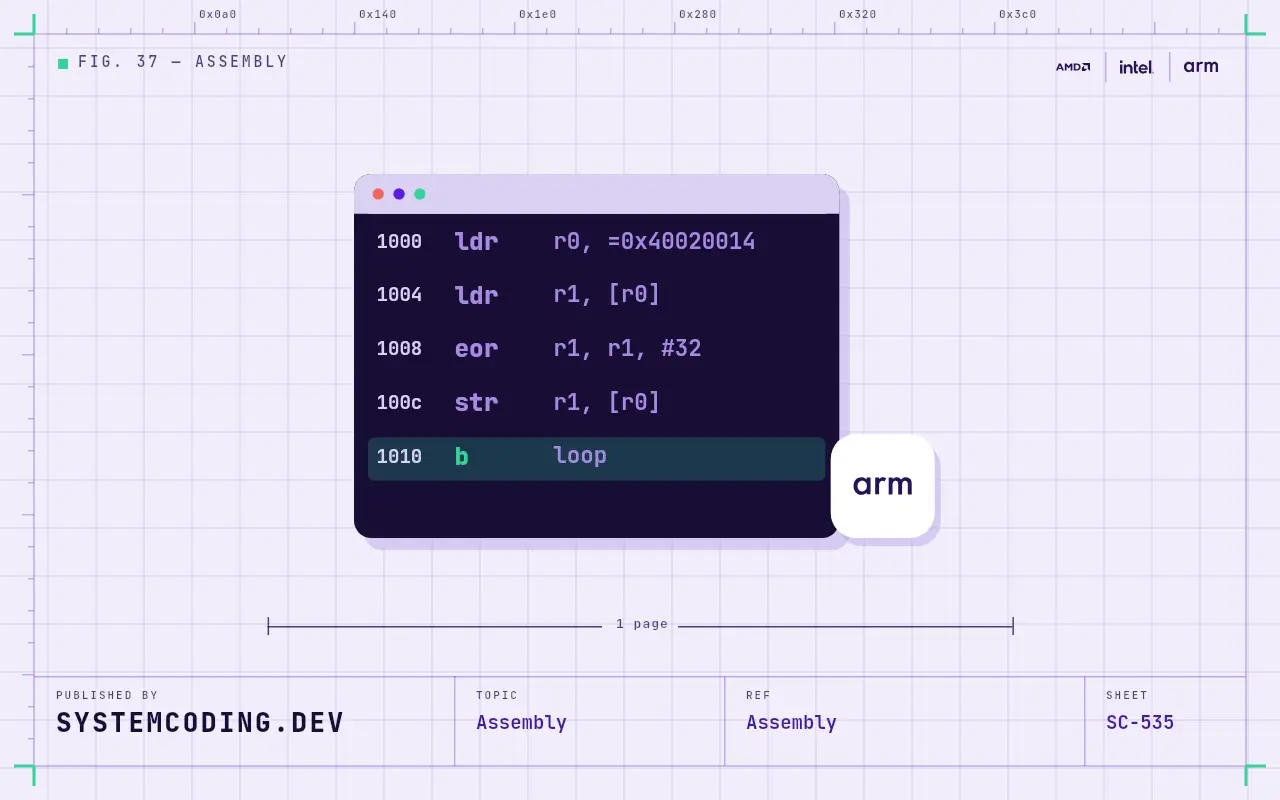
The AAPCS rules for 32-bit ARM and Cortex-M: argument and result registers, what a callee must preserve, 64-bit pairs, stack alignment and hard-float.
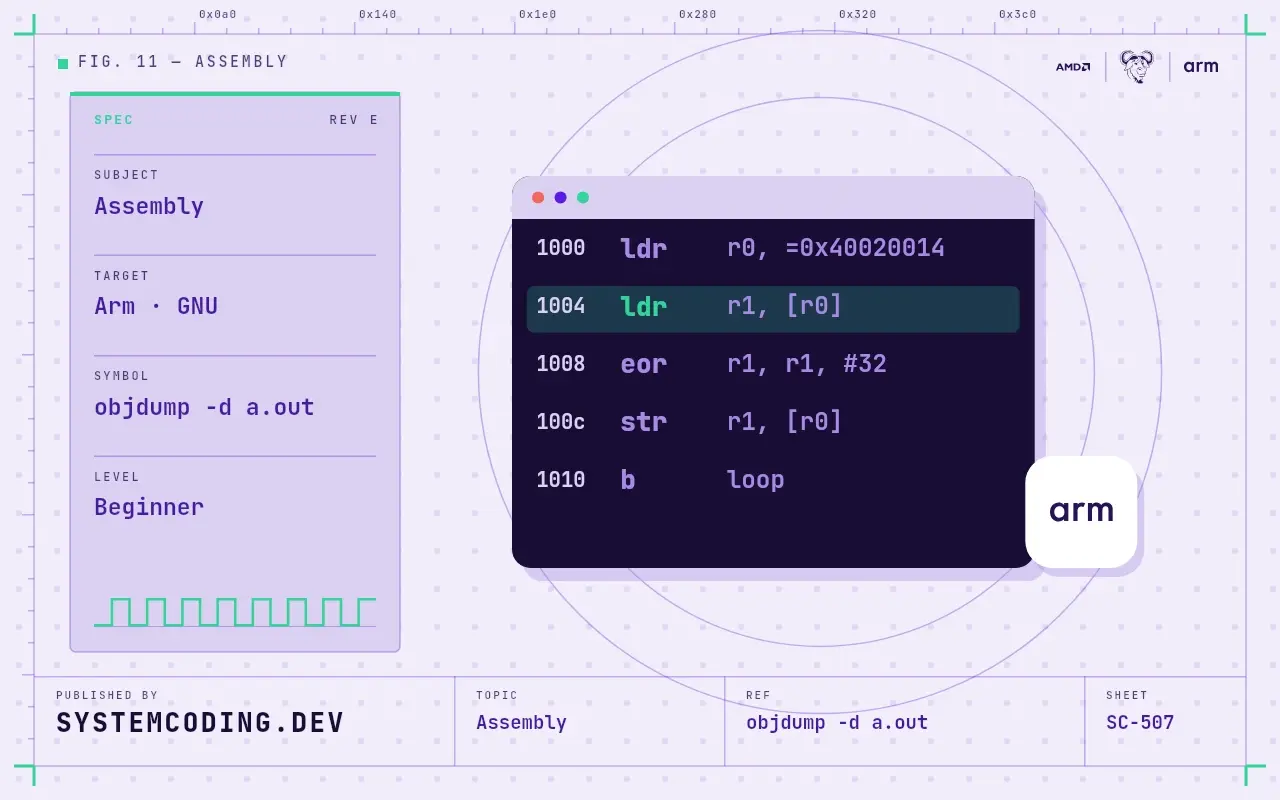
Disassemble a Cortex-M ELF with arm-none-eabi-objdump: pick sections and symbols, read the encoding columns, and spot literal pools and the vector table.
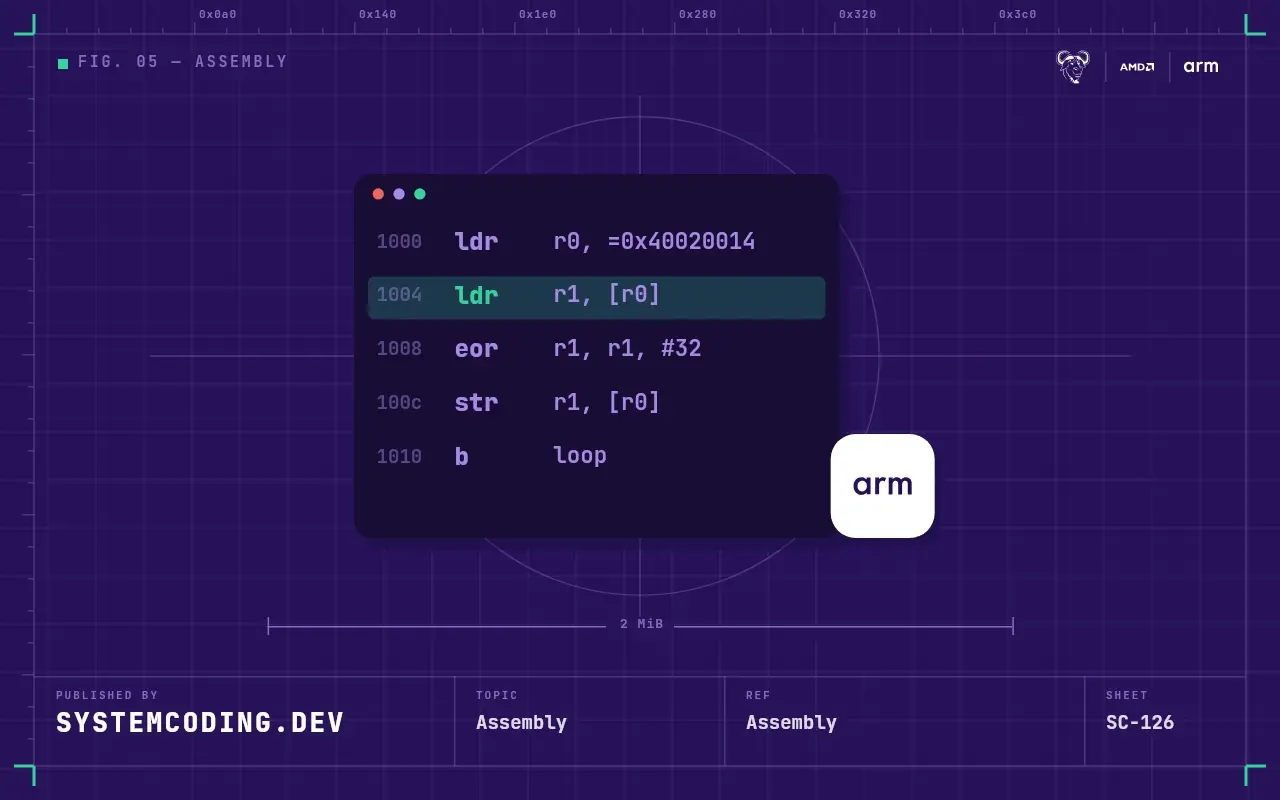
How ARM Cortex-M assembly moves data between memory and registers: LDR and STR sizes and addressing, offsets, writeback, and the multi-register LDM and STM.
We send one email when a new post is published. No spam.