What Is a Socket? Addresses, Ports and the Berkeley Sockets API
A socket is a file descriptor for one end of a network conversation. Learn addresses, ports and the Berkeley sockets calls in C on Linux.
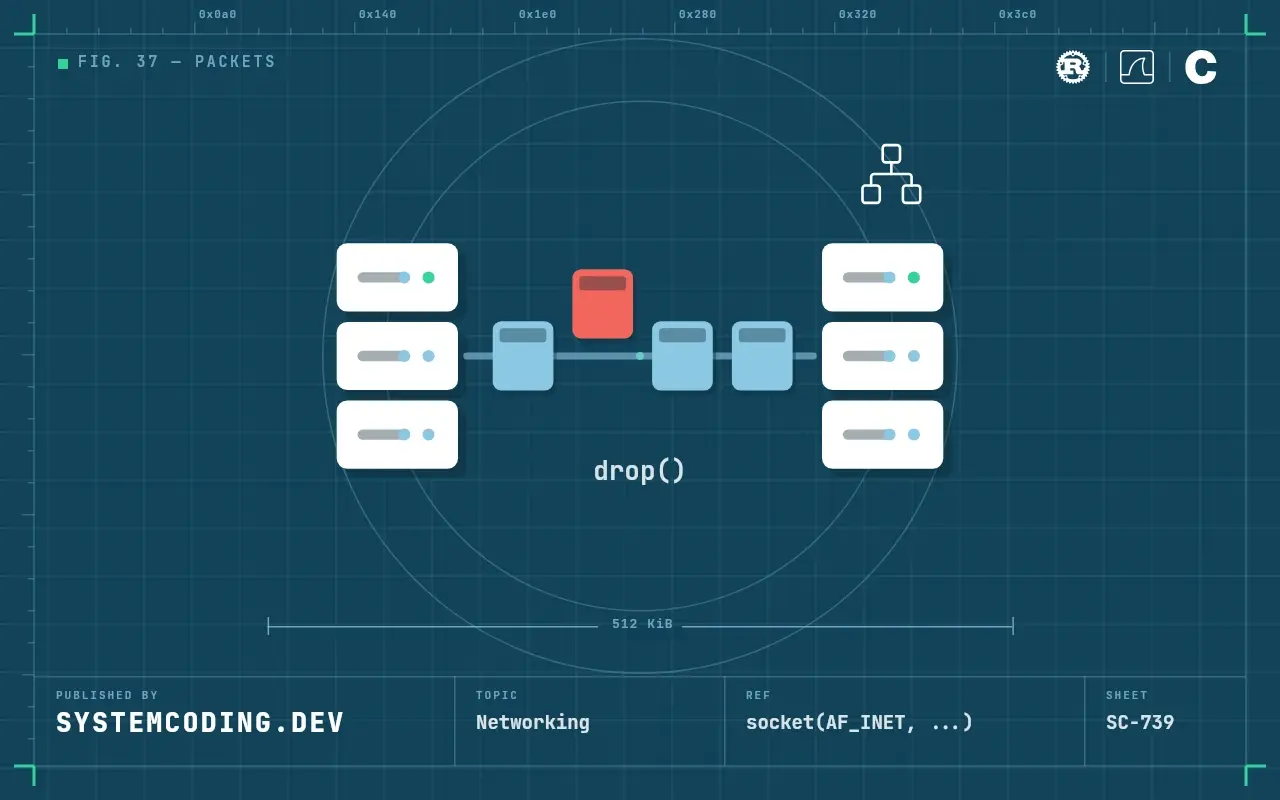
A socket is the handle a program uses to talk over a network. You ask the operating system for one, tell it which address and port to use, and then read and write it much like a file. This post defines every term you need to read a first network program: address, port, protocol, socket and file descriptor. It then walks through the Berkeley sockets API calls in C on Linux 6.12 with glibc 2.40, and ends with a small program that shows what a socket really is.
The API is specified in POSIX.1-2024, and the Linux behaviour is described in the socket(2) man page. The wider picture is in the complete guide to socket programming in C.
What a socket is
A socket is one endpoint of a two-way communication channel. The kernel owns the real object: it holds buffers for outgoing and incoming data, the connection state and the addresses involved. Your program holds only a small integer that names it, called a file descriptor.
That integer is the same kind of number you get from open for a file. This is why read, write and close work on sockets, and why poll can wait on files and sockets together. The Berkeley sockets API takes its name from the 4.2BSD Unix release of 1983, and every mainstream operating system still exposes some version of it.
A socket is not a connection. A connection is a relationship between two sockets, one on each machine. The word "socket" names a single end only.
Addresses, ports and protocols
Three ideas identify where data goes.
An address names a machine's network interface. An IPv4 address is 32 bits, written as four decimal numbers such as 192.0.2.10. An IPv6 address is 128 bits, written in hexadecimal such as 2001:db8::10. The loopback address, 127.0.0.1 for IPv4 and ::1 for IPv6, always means "this machine".
A port is a 16-bit number that picks one program on that machine. An address gets the data to the right computer, and the port gets it to the right socket. Ports below 1024 are privileged on Linux by default, so a normal user cannot bind them without a capability such as CAP_NET_BIND_SERVICE.
A protocol says how the bytes travel. Two matter on day one:
| Socket type | Constant | Protocol | Behaviour |
|---|---|---|---|
| Stream | SOCK_STREAM | TCP | A reliable, ordered byte stream between two connected endpoints |
| Datagram | SOCK_DGRAM | UDP | Independent messages that may be lost, duplicated or reordered |
A connected TCP conversation is identified by four values: source address, source port, destination address and destination port. Two clients can both connect to port 80 on the same server because their source addresses or ports differ.
The address families
The first argument to socket is the domain, also called the address family. AF_INET means IPv4, AF_INET6 means IPv6 and AF_UNIX means a local socket named by a filesystem path. Each family has its own address structure:
| Family | Structure | Holds |
|---|---|---|
AF_INET | struct sockaddr_in | a 32-bit address and a 16-bit port |
AF_INET6 | struct sockaddr_in6 | a 128-bit address, a port, a flow label and a scope id |
AF_UNIX | struct sockaddr_un | a path string |
The calls that take an address are generic, so they accept struct sockaddr * and a length. You fill in the specific structure and cast its pointer. The length tells the kernel which structure it received. Forgetting the length, or passing sizeof(struct sockaddr) for an IPv6 address, is a classic early bug, because struct sockaddr is smaller than struct sockaddr_in6.
Byte order
The port and the IPv4 address inside sockaddr_in are stored in network byte order, which is big-endian: the most significant byte comes first. Most desktop and server processors are little-endian, so a plain assignment would store the bytes the wrong way round. Use the conversion functions from <arpa/inet.h>:
htonsconverts a 16-bit value from host to network order, andntohsconverts back.htonlandntohldo the same for 32-bit values.inet_ptonparses a text address straight into network order, andinet_ntopformats one as text.
On a big-endian machine these functions do nothing, which is why you call them anyway: the code then works everywhere.
The Berkeley sockets calls
A small set of calls covers almost everything. The order depends on whether you are a server or a client.
| Call | Used by | What it does |
|---|---|---|
socket | both | Creates an endpoint and returns a file descriptor |
bind | server, sometimes client | Attaches a local address and port to the socket |
listen | TCP server | Marks the socket as passive and sets a queue for waiting connections |
accept | TCP server | Takes one finished connection and returns a new socket for it |
connect | client | Starts a connection to a remote address |
send and recv | both | Move bytes, with flags; write and read also work on connected sockets |
sendto and recvfrom | UDP | Move one datagram together with the peer address |
shutdown | both | Closes one or both directions of a connection |
close | both | Releases the file descriptor |
A TCP server runs socket, bind, listen, then loops on accept. A TCP client runs socket then connect. After that both sides exchange bytes. The listening socket and the accepted socket are different objects: the first only waits for new connections, and the second carries one conversation.
A program that creates and inspects a socket
The smallest useful program creates a TCP socket, binds it to the loopback address on a port the kernel chooses, and asks the kernel what it picked. This introduces socket, bind and getsockname without needing a second machine.
#include <arpa/inet.h>
#include <netinet/in.h>
#include <stdio.h>
#include <stdlib.h>
#include <sys/socket.h>
#include <unistd.h>

int main(void)
{
    int fd = socket(AF_INET, SOCK_STREAM, 0);
    if (fd < 0) {
        perror("socket");
        return EXIT_FAILURE;
    }

    struct sockaddr_in addr = {0};
    addr.sin_family = AF_INET;
    addr.sin_port = htons(0);                      /* 0 asks the kernel to pick */
    inet_pton(AF_INET, "127.0.0.1", &addr.sin_addr);

    if (bind(fd, (struct sockaddr *)&addr, sizeof addr) < 0) {
        perror("bind");
        close(fd);
        return EXIT_FAILURE;
    }

    socklen_t len = sizeof addr;
    if (getsockname(fd, (struct sockaddr *)&addr, &len) < 0) {
        perror("getsockname");
        close(fd);
        return EXIT_FAILURE;
    }

    char text[INET_ADDRSTRLEN];
    inet_ntop(AF_INET, &addr.sin_addr, text, sizeof text);
    printf("socket fd = %d\n", fd);
    printf("bound to %s port %u\n", text, (unsigned)ntohs(addr.sin_port));

    close(fd);
    return EXIT_SUCCESS;
}
Compile it with gcc -std=c11 -Wall -Wextra -D_DEFAULT_SOURCE -o sockinfo sockinfo.c. A run prints:
socket fd = 3
bound to 127.0.0.1 port 41327
The descriptor is 3 because 0, 1 and 2 are standard input, output and error, and socket returns the lowest unused number. The port will differ on each run, because asking for port 0 lets the kernel choose an unused one from its ephemeral range. The second argument to socket, SOCK_STREAM, selected TCP, and the third argument, 0, means "use the default protocol for this type".
The {0} initializer matters. struct sockaddr_in has padding fields, and leaving them with garbage can make bind fail on some systems.
Errors and the return convention
Every call above returns -1 on failure and sets errno. Read it with perror or strerror. Three errors show up on the first day:
EADDRINUSEfrombindmeans another socket already holds that address and port.ECONNREFUSEDfromconnectmeans nothing is listening there.EACCESfrombindmeans you asked for a privileged port without permission.
Check every return value. A network program that ignores them fails silently, and the failure then appears two calls later as a confusing message about a bad file descriptor.
Common mistakes
Beginners tend to repeat the same few errors:
Storing a port or address in host order. The program compiles and runs, but connects to the wrong port.
Assuming one
sendcall is onerecvcall on TCP. TCP is a byte stream with no message boundaries, so a singlerecvmay return part of a message or several messages joined together.Using the listening descriptor to exchange data. Only the descriptor returned by
acceptcarries a conversation.Forgetting to
closedescriptors, which leaks them until the process hits its limit, reported asEMFILE.