Monolithic vs Microkernel vs Hybrid Kernel Designs Compared
Monolithic, microkernel and hybrid kernels differ in how much runs at top privilege; this compares Linux, MINIX 3, seL4 and Windows NT with a decision table.
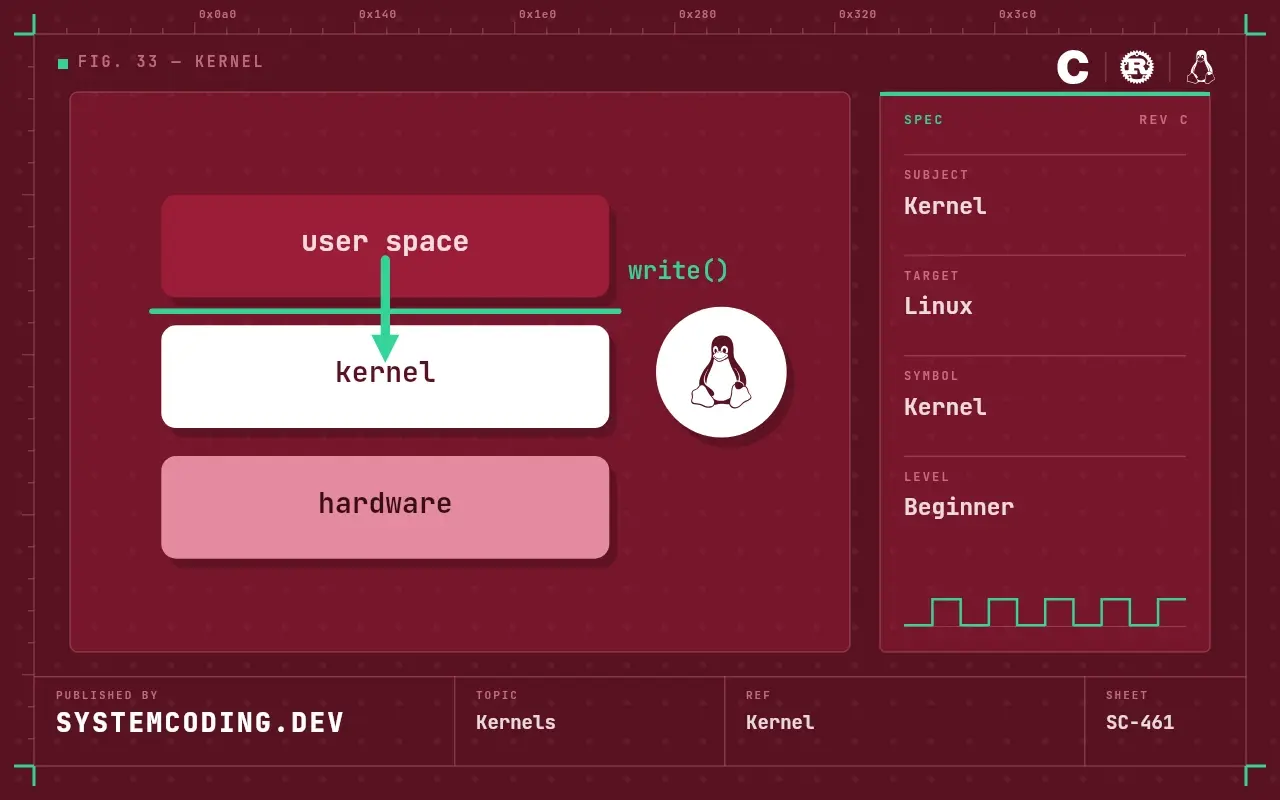
The question is where the boundary sits
Every kernel design answers the same question: which operating system services run in the privileged core, and which run as ordinary programs outside it? Put everything inside and you get a monolithic kernel. Put almost nothing inside and you get a microkernel. Put some things in and leave others out for pragmatic reasons and you get what people call a hybrid.
The labels are looser than they sound, so this post defines each by what actually runs in kernel mode, names a real system for each, and ends with a table for choosing. Examples are Linux 6.12 LTS, MINIX 3, seL4 and Windows NT, all of which have public design documentation.
Monolithic kernels
In a monolithic kernel, the scheduler, memory manager, file systems, network stack and device drivers all run in the same privileged address space. Calling from one to another is an ordinary function call, with no context switch and no message copying.
Linux is the standard example. When a process calls read() on a file stored on ext4 over an NVMe drive, the path runs through the VFS layer, the ext4 code, the block layer and the NVMe driver without ever leaving kernel mode:
read(fd)
  -> ksys_read()
    -> vfs_read()
      -> ext4_file_read_iter()
        -> generic_file_read_iter() / filemap_read()
          -> (page cache miss) -> submit_bio()
            -> blk_mq_submit_bio()
              -> nvme_queue_rq()
Each arrow is a direct call. That is the monolithic design's main strength: speed through shared memory and no crossing cost between components.
The cost is blast radius. A bug in the NVMe driver runs with the same privilege as the scheduler, so a wild pointer in a driver can corrupt anything. Linux manages this with code review, static analysis, and a runtime toolbox (KASAN, lockdep) rather than architectural isolation. Loadable modules make the design flexible, but a loaded module is still part of the kernel in every sense that matters for privilege.
Microkernels
A microkernel keeps in privileged mode only what must be there: address space switching, thread scheduling, interrupt delivery and inter-process communication (IPC). File systems, drivers and network stacks run as separate user-mode servers. A client that wants a file sends a message to the file server, which sends a message to the disk driver.
The same read() in a microkernel looks like this:
app          : send(FS_SERVER, READ, fd, buf)
FS server    : send(DISK_DRIVER, READ_BLOCK, block, buf)
disk driver  : programs the controller, waits for the interrupt
disk driver  : reply(FS_SERVER, data)
FS server    : reply(app, data)
MINIX 3 is the textbook case. It runs drivers and servers as separate processes and has a reincarnation server that restarts a crashed driver. seL4 goes furthest: its kernel is small enough that its functional correctness has been proved formally against a specification, as published by the seL4 Foundation.
The benefit is fault isolation. A crashing network driver is a crashed process, not a crashed machine, and the kernel's small size makes it practical to verify. The cost is IPC overhead. Every service call becomes at least two context switches and a message copy or a shared-memory handoff, so the whole performance story depends on making IPC extremely fast. Second-generation microkernels such as L4 and seL4 spent their design effort on exactly that.
Hybrid kernels
"Hybrid" is the name for kernels that started with microkernel ideas and moved performance-critical services back into kernel mode. It is a pragmatic label, not a precise one, and some kernel developers reject it as marketing.
Windows NT is the usual example. Its executive (I/O manager, memory manager, object manager, security reference monitor) and most drivers run in kernel mode in one address space, much like a monolithic kernel. But its architecture keeps subsystem boundaries, a layered driver model and user-mode subsystems such as the Win32 environment, which is a microkernel-inspired structure.
XNU, the kernel of macOS and iOS, combines the Mach microkernel with a BSD layer and the I/O Kit driver framework in one kernel address space. Mach provides tasks, threads and messaging; BSD provides the POSIX interface; both run in kernel mode together. Apple has also been moving some drivers out into user space through DriverKit.
A concrete comparison
The sections above describe designs. This table puts the differences on the dimensions a systems programmer usually cares about.
| Property | Monolithic (Linux) | Microkernel (MINIX 3, seL4) | Hybrid (NT, XNU) |
|---|---|---|---|
| Code in privileged mode | Everything, including drivers | Scheduler, memory, IPC only | Core services plus most drivers |
| Service call cost | Function call | IPC round trip | Mostly function call |
| Driver crash | Can take the system down | Restart the driver process | Can take the system down |
| Attack surface in kernel mode | Large | Small | Large |
| Formal verification | Impractical | Done for seL4 | Impractical |
| Extension model | Loadable modules, same privilege | Separate user processes | Kernel drivers plus user-mode frameworks |
| Typical use | Servers, phones, embedded Linux | Safety-critical, security-critical | Desktop and mobile OS |
Notice that a microkernel's advantage in the table is isolation, and a monolithic kernel's is directness. Neither dominates, which is why all three families are in production.
Choosing between them
You rarely pick a kernel design in isolation; you pick a kernel for a job and inherit its design. These are the rules of thumb that hold up.
Choose a monolithic kernel when you need broad hardware support, a large driver ecosystem and mature tooling. This is the default for servers, desktops and most embedded Linux products.
Choose a microkernel when a bug in a driver must not be able to compromise or crash the rest of the system, and when you can afford to write or port drivers as user-mode services. Examples are avionics, medical devices and security separation kernels.
Accept a hybrid when you want the desktop ecosystem of a vendor and its driver model, and the design is a given rather than a choice.
When none of these labels help
The categories describe where code runs, not how good the design is. A microkernel with poorly written servers is not more reliable than a carefully reviewed monolithic kernel. And Linux itself blurs the line: FUSE runs file systems in user space, UIO and VFIO let drivers live outside the kernel, and eBPF runs verified user-supplied programs inside it. A real kernel is a position on a spectrum, not a category.
A note on the famous argument
In 1992 Andrew Tanenbaum posted that Linux was obsolete because it was monolithic, and Linus Torvalds replied in the same Usenet thread. The thread is worth reading for the arguments rather than the tone. The practical outcome is that both designs shipped and found their niches. Linux runs most servers and phones; microkernel designs run places where isolation and assurance outweigh raw throughput.


